


Abstract
PURPOSE We tested whether patients are more likely to pursue healthy behaviors (eg, physical activity, smoking cessation) if referred to a tailored Web site that provides valuable information for behavior change.
METHODS In a 9-month pre-post comparison with nonrandomized control practices, 6 family practices (4 intervention, 2 control) encouraged adults with unhealthy behaviors to visit the Web site. For patients from intervention practices, the Web site offered tailored health advice, a library of national and local resources, and printouts for clinicians. For patients from control practices, the Web site offered static information pages. Patient surveys assessed stage of change and health behaviors at baseline and follow-up (at 1 and 4 months), Web site use, and satisfaction.
RESULTS During the 9 months, 932 patients (4% of adults attending the practice) visited the Web site, and 273 completed the questionnaires. More than 50% wanted physician assistance with health behaviors. Stage of change advanced and health behaviors improved in both intervention and control groups. Intervention patients reported greater net improvements at 1 month, although the differences approached significance only for physical activity and readiness to change dietary fat intake. Patients expressed satisfaction with the Web site but wished it provided more detailed information and greater interactivity with clinicians.
CONCLUSIONS Clinicians face growing pressure to offer patients good information on health promotion and other health care topics. Referring patients to a well-designed Web site that offers access to the world’s best information is an appealing alternative to offering handouts or impromptu advice. Interactive Web sites can facilitate behavior change and can interface with electronic health records. Determining whether referral to an informative Web site improves health outcomes is a methodological challenge, but the larger question is whether information alone is sufficient to promote behavior change. Web sites are more likely to be effective as part of a suite of tools that incorporate personal assistance.
- Diet, physical activity
- smoking cessation
- alcohol drinking
- obesity
- health promotion
- practice-based research
- communication
- delivery of health care
- health services research
INTRODUCTION
Four unhealthy behaviors—poor diet, physical inactivity, tobacco use, and problem drinking—constitute the leading causes of death in the United States,1 but clinicians face obstacles in helping patients to pursue behavior change.2 The barriers include too little time with patients, limited reimbursement, and uncertainties about the effectiveness of the low-intensity interventions that most practices can deliver.3–8
One challenge is connecting patients with the information resources they need to pursue healthy behaviors. Having been encouraged by clinicians to change their lifestyle, patients often seek details regarding techniques, motivational strategies, resources, and community programs, but the information that clinicians can provide in their offices is often limited, outdated, or commercially biased. Increasingly, consumers want information to be tailored and interactive. For their part, practices lack the time and resources to assess systematically the health behaviors of patients, their individual stages of readiness to change, or the type of assistance that patients need.9
Both inefficiency in connecting patients with individually tailored information and systematically assessing behaviors and patient expectations can benefit from Web site technology.10 A Web site for patients could host the best information available on healthy lifestyle and liberate practices from the need to keep such materials on file. The Web site would enable the practice to extend educational outreach beyond the time and place of the clinical encounter, empowering patients with convenient access to the most appropriate information as and when they need it. Interactive sites can also collect information on individuals’ health behaviors and expectations. Whether a Web site performing these functions would facilitate behavior change is unclear.
We developed and tested the effectiveness of such a Web site, with support from the Robert Wood Johnson Foundation Prescription for Health program.11 The My Healthy Living (MHL) Web site (http://www.myheal-thyliving.net) combined 4 features: (1) an intake assessment that collected a behavioral history and assessed stage of readiness to change; (2) an individually tailored resource library with links to Web pages from national organizations and agencies; (3) links to local resources, including Web services offered by patients’ practices; and (4) tailored health advice and printouts for clinicians.
METHODS
During the course of 9 months, 6 primary care practices (4 intervention and 2 control) encouraged adults with unhealthy behaviors to visit the MHL Web site. Web site visitors completed a behavioral history. Intervention and control conditions were assigned nonrandomly. Patients from intervention practices were directed to Web pages with extensive health promotion resources, whereas patients from control practices were directed to static pages with limited information. In a pre-post comparison at intervention and control practices, data on health behaviors, readiness to change, and user satisfaction were obtained from e-mail questionnaires sent to patients 1 and 4 months after their first Web site visit. Participating practices were affiliated with the Virginia Ambulatory Care Outcomes Research Network (ACORN).12 We detail our methods in the Supplemental Appendix, available online-only at http://www.annfammed.org/cgi/content/full/4/2/148/DC1.
RESULTS
The Supplemental Appendix provides a full report of our study findings. In summary, 932 patients visited the MHL Web site, of whom 29% (n = 273) enrolled in the study (an estimated 25,488 unique adults attended the practices during the 9 months). The small number of recruited patients compromised the statistical power of the study. Among this subgroup, substantial majorities reported physical inactivity and unhealthy diet, and most (77% to 94%) classified themselves in preaction stages. More than one half of the patients (55% and 53%, respectively) wanted their physician’s help with diet or physical inactivity.
Four months after their first Web site visit, stage of change and health behaviors had improved in patients at both the intervention and control practices. Intervention practice patients reported greater improvements at 1 month than did control practice patients, a nonsignificant trend across multiple behaviors (Figure 1⇓). The difference at 1 month reached or approached statistical significance in relation to light to moderate physical activity (stage, P = .02; behavior, P = .10) and readiness to change dietary fat intake (P = .06), but no significant differences persisted at 4 months. Users liked the Web site; 64% said that it was helpful, and 52% revisited 2 to 5 times. To improve the MHL Web site, users recommended more detailed information and interactivity with clinicians.
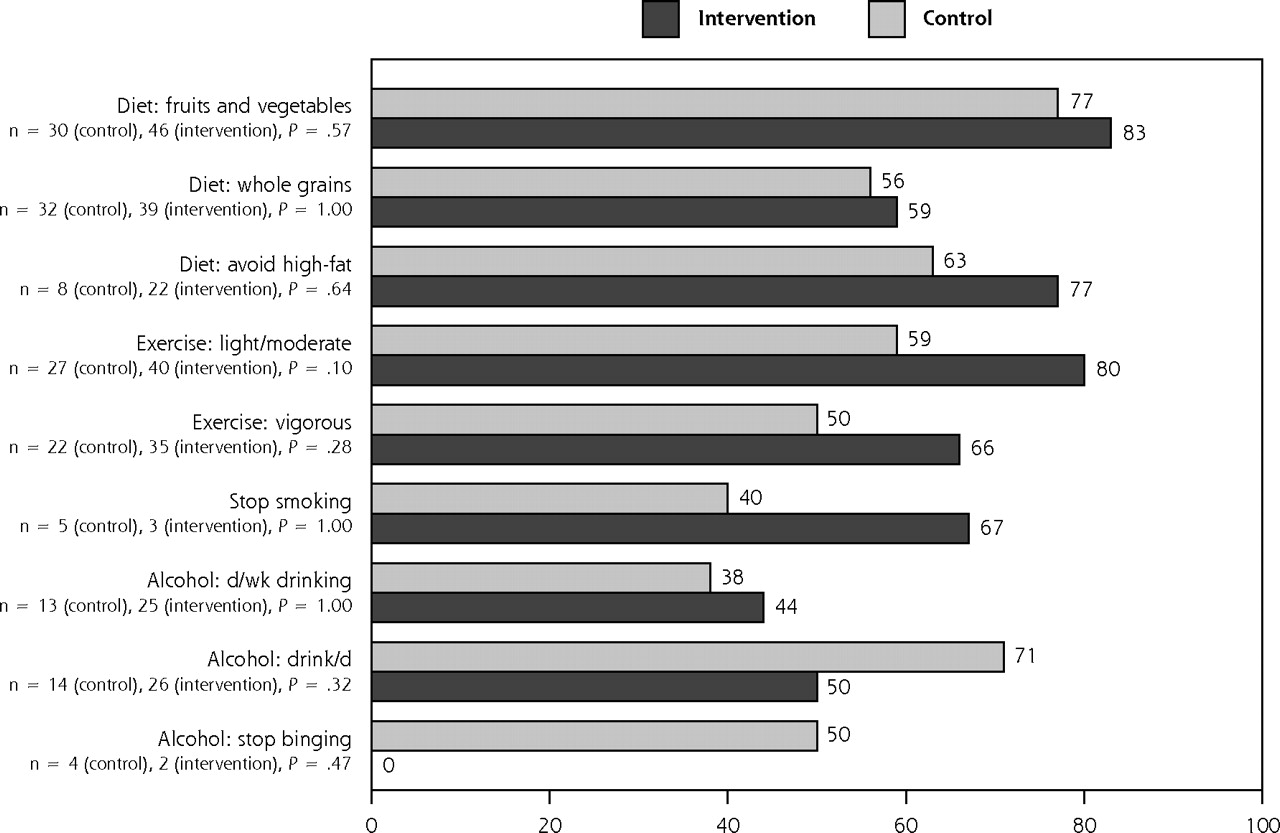
One-month behavior change among intervention and control patients.
Note: The bars portray the percentage of patients whose behavior improved at 1 month (n = number of patients whose behavior changed). The comparison is among patients who indicated a change in behavior. Proportional change was computed as behavior improved ÷ (100% - no change). Some round-off error may have occurred. The P value is based on Fisher’s exact test,13 comparing intervention with control percentage improvements.
DISCUSSION
Clinicians and practices face a growing need to offer patients high-quality information on both lifestyle change and other health care topics.14 Referring patients to a well-designed Web site offers a more complete and systematic alternative to the conventional practice of offering impromptu advice during the visit or distributing the handouts that happen to be in the office. The Web site can give patients instantaneous access to the world’s best information, which they can browse leisurely and at their convenience. The public has grown accustomed to using personal computers and other technology to manage personal affairs in most aspects of daily life.15 The inability to do the same in the personal management of health and health care grows increasingly problematic.
Interactive sites not only empower the consumer with greater control over knowledge but can also offer layered information that can individualize guidance, track progress, and support behavior change as needs and stages of change evolve with time. Personal health records, into which patients enter their own historical and clinical data, provide a tool for health maintenance and can interface with electronic health records and other practice information technologies.16 The secure integration of practice and consumer information systems offers a modern vehicle for merging what were once separate interventions, eg, patient education, decision aids, patient reminders, and clinician prompts.
These potential benefits may account for the enduring interest in the MHL Web site beyond completion of the study. The practices that participated have since requested that the Web site remain in operation as an ongoing service to their patients. Our group, along with other practice-based research networks, is using an upgraded version of the MHL Web site in a second round of studies funded by the Robert Wood Johnson Foundation Prescription for Health program.17 Networks in other states have expressed interest in providing access to the MHL Web site for their patients.
What remains unclear, however, is whether exposure to such a Web site improves health outcomes. The results of our study, detailed in the Supplemental Appendix, suggest a salutary effect on stage of change and health behaviors, but statistical power to measure a clear effect was lacking because of the relatively small number of Web site visitors. Only 4% of adult patients visited our Web site. This low visit rate was surprising in the face of high Internet use in the local population18 and apparent enthusiasm for the Web site among patients. For example, patients rapidly exhausted practices’ supplies of pads with tear-off sheets listing the Web site address. Practices and clinicians vigorously encouraged patients to visit the Web site.19
In the Supplemental Appendix, we put the low Web site visit rate in context, citing, for example, the small subset of patients for whom MHL was intended. We review circumstances that may have tempered the number of Web site visitors and diluted the observed effect on stage of change and health behaviors, including possible shortcomings in practice promotion of the Web site, server failures, limited representation of young adults, the short (9-month) observation period, and contamination of the control group. The Supplemental Appendix describes other study limitations, such as its nonrandom design.
Our data therefore cannot clarify whether the low rate of visits to the MHL Web site is a generalizable indictment of patient interest in health promotion Web sites or reflects some aspect of our technique or promotional strategy. In the Supplemental Appendix we discuss strategies not used in our study that might have increased the utility and use of the Web site. Future studies should identify the most effective features to motivate patients to visit (and return to) Web sites for health information. Until then, our operational premise for developing the MHL Web site—if you build it, patients will come—remains an open question until a Web site with optimal features is evaluated in a study with the proper design.
The larger question, however, is whether information alone, provided by a Web site or by other media, is sufficient to help patients sustain long-term behavior change. Directing patients to a Web site with no further follow-up (eg, telephone, e-mail, office visit) may be inadequate to change lifestyle. Most MHL users classified themselves in preaction stages (for diet and physical inactivity), but 45% to 68% were in the precontemplation or contemplation stages. These patients may lack the motivation to alter their lifestyle or sustain changes based only on the information they view on a Web site and without social and environmental supports (eg, familial), personal counseling, and follow-up.
Indeed, one would not expect a single intervention to change behavior.20 Rather, electronic tools to help patients access information would presumably yield their greatest benefit as part of an integrated suite of tools that practices would offer patients, preferably in a stepwise fashion based on personal needs.21–23 The Web site might be used in isolation by patients who are self-motivated and comfortable with computers, or in combination with other options by patients who seek personal contact or more intensive assistance for motivation and support. For example, in an ongoing Prescription for Health study, we are testing such a multicomponent intervention in which the MHL Web site is among several options (telephone counseling, e-counseling, group classes) from which patients can choose to obtain more intensive assistance with behavior change.
Whether Web sites are an essential component of the suite of interventions that practices should offer patients, the need for an effective set of options is mounting. The prevalence of obesity in the United States is climbing dramatically.24,25 Primary care physicians face not only a public health imperative to address health behaviors but also consumer demand. More than 50% of our patients in this study wanted assistance with health behaviors, primarily physical activity and diet. Responding to this need with a menu of helpful options appears crucial to accommodate variability in patients’ needs. The capability of Web sites to assemble and individualize high-quality resources makes these sites important to consider in the ensemble of options.
The unintended consequences of the MHL model deserve attention along with its potential benefits. For example, clinicians who refer patients to a Web site for health promotion might grow inattentive to lifestyle issues and make unfounded assumptions that patients are receiving the counseling and support that they need. If technologies such as MHL take lifestyle issues off the agenda of the patient-clinician encounter, clinicians may become less attuned to behavioral risk factors that are pertinent to illness care. Finally, the costs to practices of establishing Web sites are substantial; much of the $125,000 grant that supported this study was devoted to creating the Web site. Once established, however, the Web site is inexpensive to maintain and far more affordable than paying for clinician time to deliver in-person lifestyle counseling. The net cost of adopting such a system therefore deserves study.
Enabling patients to use their computers more interactively for personal health management creates possibilities that far exceed the functions performed by the MHL Web site.26 Fully 94% of patients who visited our Web site were willing to answer online questions about health history. Systems that share such information with clinicians could obviate the need to sacrifice time during appointments for this task. Patients’ answers can be used to update medical records, populate electronic health records, and prompt clinicians about health habits and clinical services needing attention.27–33
Users wanted the MHL Web site to provide greater detail and interactivity with clinicians. Future Web sites can enable patients to examine their records and test results, visit resource libraries and Web sites to broaden their knowledge, arrange live or asynchronous consultations with e-counselors, receive follow-up e-mails for reminders or reinforcement, and participate in longitudinal tracking for research.34–40 Whether offering these tools to patients improves health outcomes or satisfaction with care awaits further study with longer observational periods.
Acknowledgments
We thank Marshall Thompson, David Williams, the Virginia Commonwealth University Department of Computer Sciences, and Creative Services, for their invaluable assistance in developing the Web site. Comments of the editors and anonymous reviewers regarding previous drafts of this manuscript were extremely helpful. We thank the management, medical staff and project champions at the 6 participating practices: Fairfax Family Practice Center, Fairfax; Broadlands Family Practice, Ashburn; Herndon Family Medicine, Herndon; Prince William Family Medicine, Manassas; Town Center Family Medicine, Reston; and Vienna Family Medicine, Vienna. We thank the American College of Preventive Medicine, our national partner, and our local partners: Fairfax County Park Authority, Fairfax-Falls Church Community Services Board - Alcohol and Drug Services, Inova Health System, and Community Alcohol Treatment Services. We also thank Russell E. Glasgow, PhD, Susan A. Flocke, PhD, and Claudio R. Nigg, PhD, for their professional advice, and the staff of the national entities that gave further input on MHL: American Cancer Society, American Heart Association, American Diabetes Association, American Academy of Family Physicians, American College of Physicians, Agency for Healthcare Research and Quality, Centers for Disease Control and Prevention, and National Institutes of Health.
Footnotes
-
Conflicts of interest: none reported
-
Funding support: This study was supported by a Robert Wood Johnson Foundation Prescription for Health grant (No. 049060).
- Received for publication April 29, 2005.
- Revision received October 10, 2005.
- Accepted for publication October 26, 2005.
- © 2006 Annals of Family Medicine, Inc.


